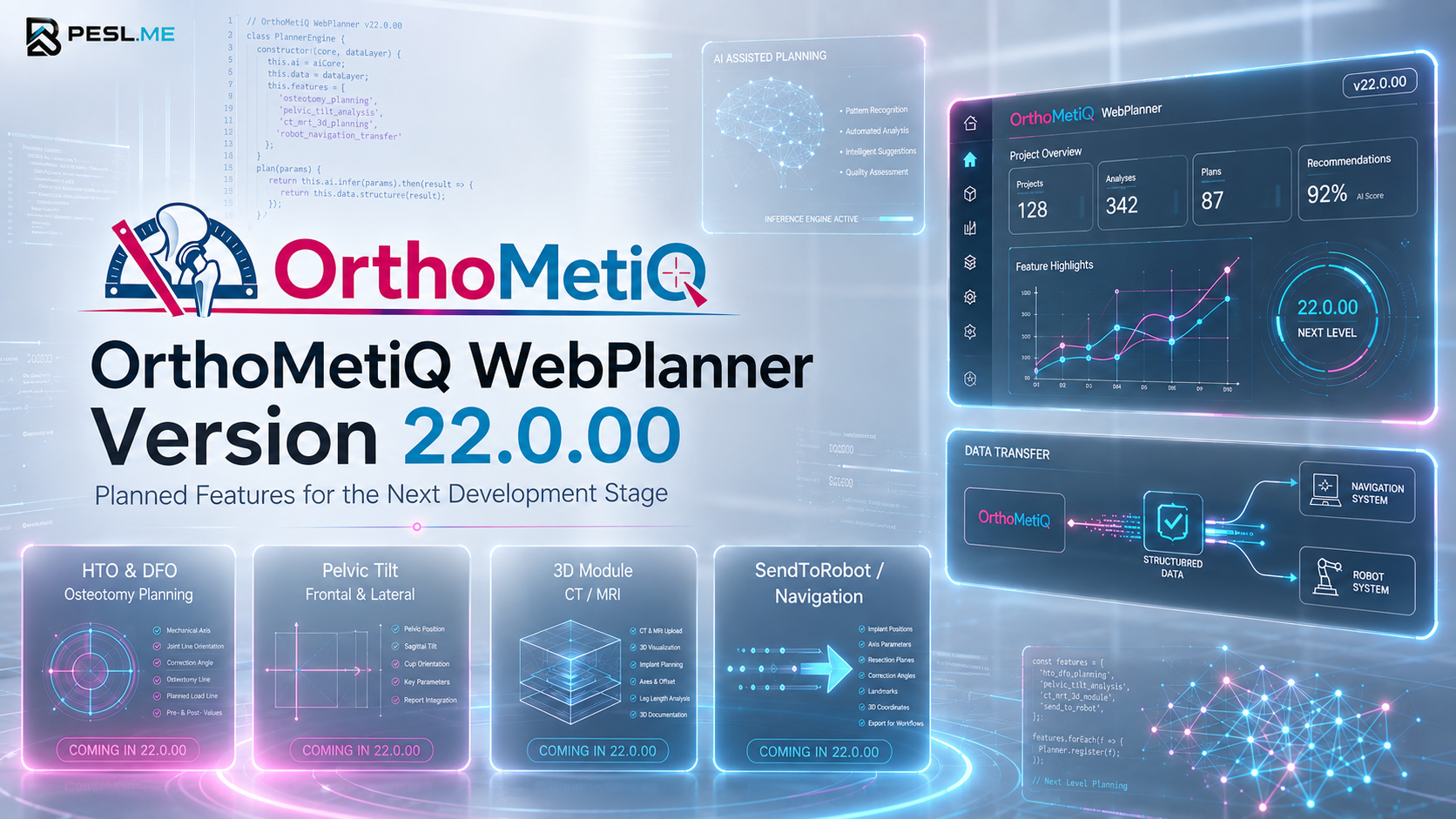
With the upcoming Version 22.0.00, OrthoMetiQ is preparing to expand the WebPlanner with important new functional areas for digital preoperative planning. All planned extensions are intended to be available to customers with a valid subscription.
The focus will be on four key developments:
- Knee osteotomy planning with HTO & DFO
- Pelvic Tilt analysis in frontal and lateral X-ray views
- 3D planning with CT and MRI image sources
- Preparation of structured data transfer to navigation and robotic systems
The objective is to make preoperative planning even more precise, clinically relevant and digitally connected.
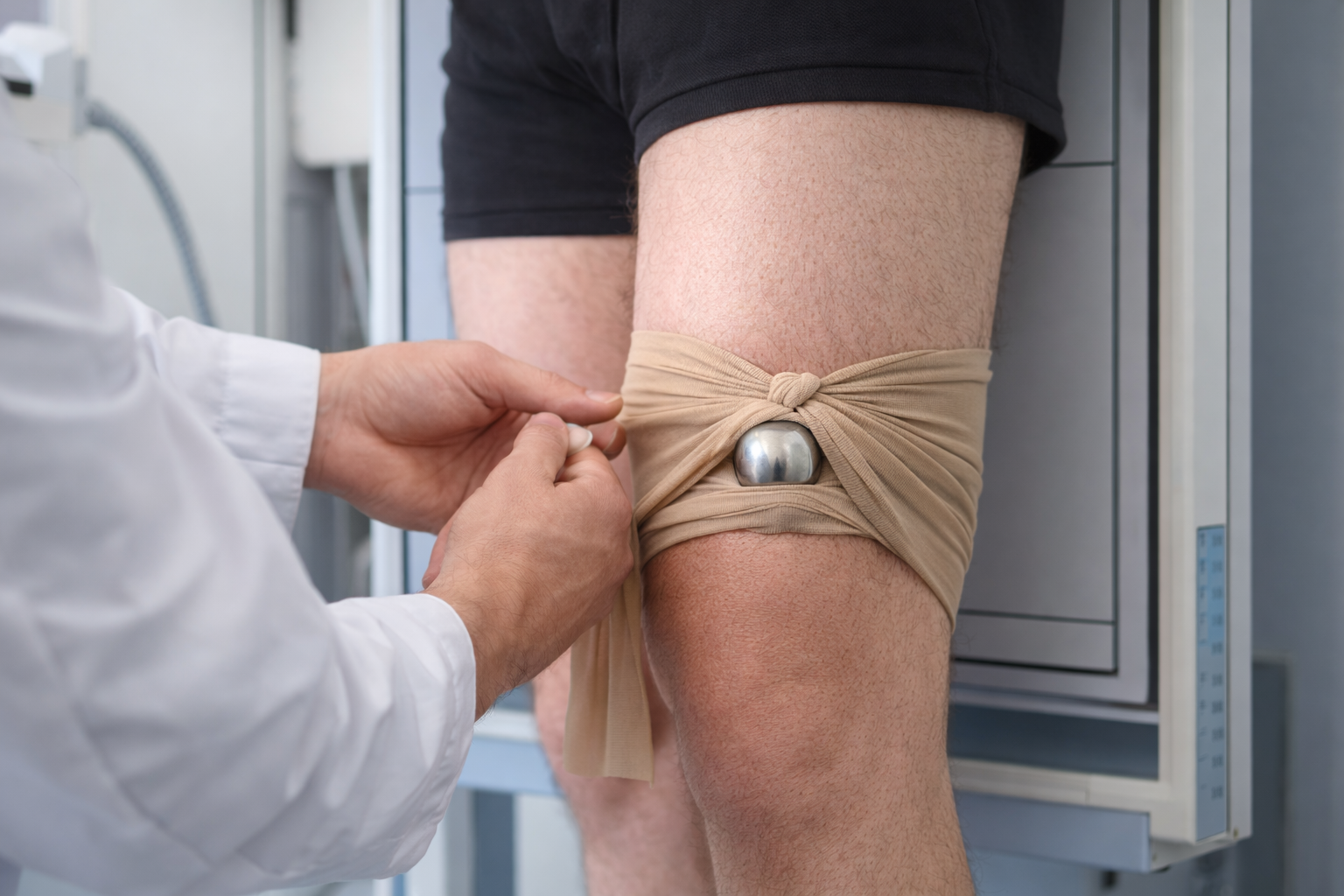
Knee Osteotomy - HTO & DFO
With Version 22.0.00, OrthoMetiQ plans to extend the WebPlanner with digital tools for knee osteotomy planning.
HTO - High Tibial Osteotomy is primarily used for tibial-based alignment deformities, often to unload the medial knee compartment in cases of varus alignment. DFO - Distal Femoral Osteotomy involves the distal femur and is particularly relevant when the alignment deformity is mainly caused by the femur.
The WebPlanner is intended to support the structured analysis of relevant axes and correction parameters, including:
- Mechanical leg axis
- Joint line orientation
- Correction angle
- Osteotomy line
- Planned postoperative load-bearing line
- Documentation of preoperative and planned values
This allows osteotomy planning to be prepared not only visually, but also in a measurable, traceable and reportable way.
Pelvic Tilt in Frontal and Lateral Views
Another planned functional area is the analysis of Pelvic Tilt. Pelvic position can directly influence the functional orientation of the acetabulum and may therefore be relevant in hip arthroplasty planning.
While the frontal view continues to support important parameters such as leg length discrepancy, offset, cup center and implant positioning, the lateral view adds sagittal assessment of the pelvis.
A combined evaluation is planned for:
- Frontal pelvic position
- Sagittal pelvic tilt
- Functional cup orientation
- Relevant hip and pelvic parameters
- Documentation in the planning report
This is intended to add a functional component to hip planning, especially in more complex anatomical situations or in cases with abnormal pelvic positioning.
New 3D Module for CT and MRI Data
With Version 22.0.00, OrthoMetiQ is also planning to introduce 3D planning. Users will be able to upload CT or suitable MRI image sources and plan implants in a three-dimensional environment.
CT data is particularly relevant for bony reconstruction and implant planning, as it enables precise spatial visualization of the anatomy. MRI data may provide additional information depending on the clinical question and imaging quality.
The planned 3D module is intended to enable:
- Upload of CT and MRI image sources
- Three-dimensional visualization of anatomical structures
- Selection and positioning of digital implants
- Assessment of size, position and alignment
- Analysis of axes, offset and leg length
- Documentation of the 3D planning
This will extend classic 2D planning with a spatial planning layer for more complex cases.
SENDTOROBOT / NAVIGATIONSYSTEM
Another development area is the future preparation of structured planning data for navigation and robotic systems.
This is not about automatic surgery. It is about digitally providing relevant planning information in a structured format. Surgical decision-making remains entirely with the surgeon.
In the future, the following data may be relevant:
- Implant positions
- Axis parameters
- Resection planes
- Correction angles
- Landmarks
- 3D coordinates
- Export data for validated downstream processes
This is intended to further develop the OrthoMetiQ WebPlanner not only as planning software, but also as a digital component of modern surgical preparation.
No Magic - No Obligation - Just Passion
The planned features of Version 22.0.00 clearly show where OrthoMetiQ is heading: from a modern browser-based planning environment towards a comprehensive digital platform for preoperative analysis, implant planning and structured surgical preparation.
OrthoMetiQ focuses on:
- Clinical relevance
- Precise measurement logic
- Clear visualization
- Rapid development
- Customer proximity
- Future-ready digital workflows
In only a few months, a new development stage of the WebPlanner is taking shape - not through magic, not through obligation, but through experience, passion and the clear ambition to make digital planning better, faster and more user-friendly.